Family Airline Seating: How to Sit Together on Flights
Learn how family airline seating actually works when airlines guarantee it, when they don't, and how to improve your odds of sitting together.
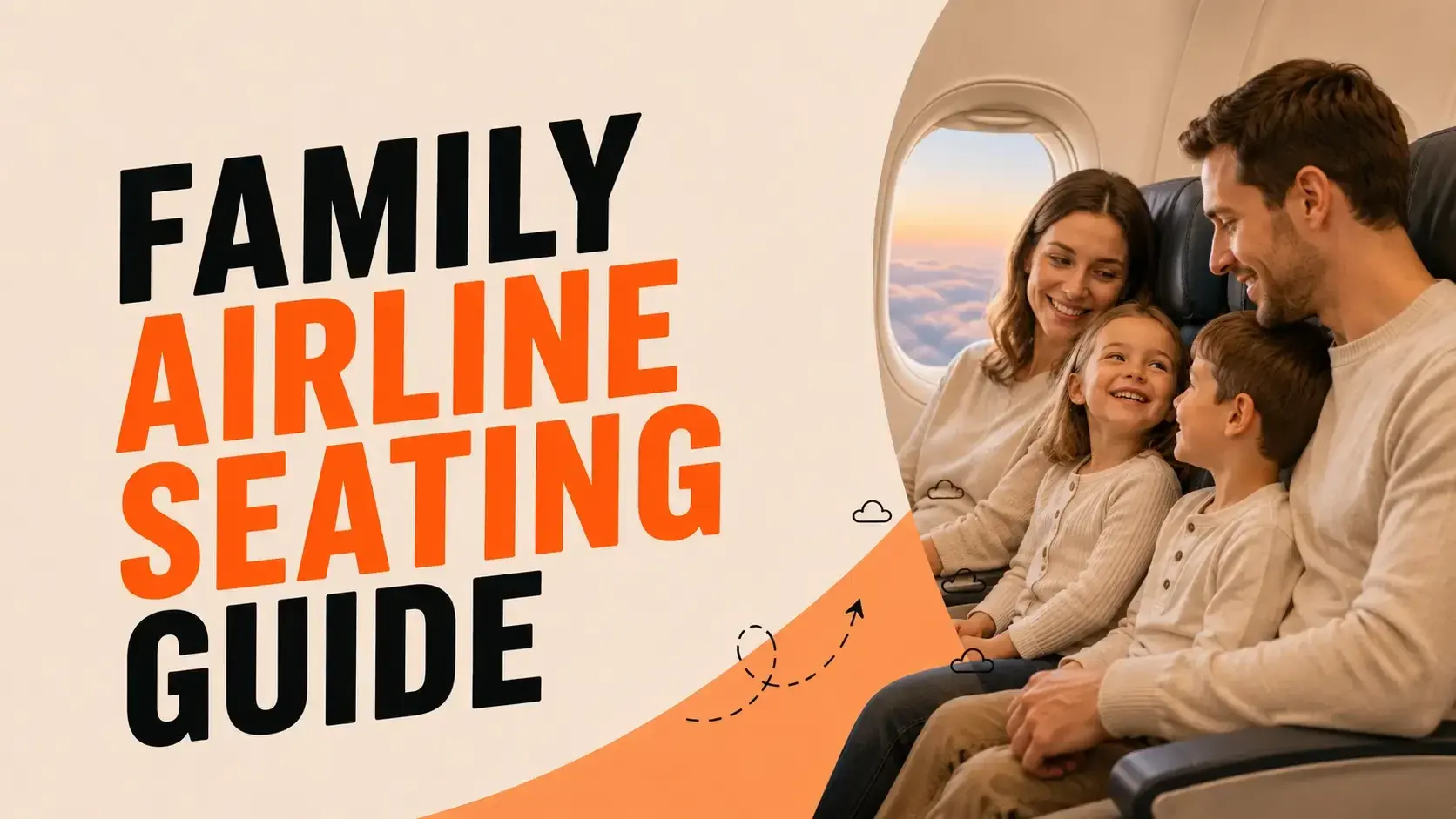

Family Airline Seating: How Airlines Seat Families Together (and When They Don't)
You booked a flight for your family, but the app shows scattered seats across the cabin. Maybe you booked a budget fare. Maybe the flight is nearly full. Now you are wondering if the airline will fix it, or if you need to fix it yourself. Understanding family airline seating rules can save you a lot of last-minute stress.
Does an airline guarantee your family will sit together? What happens if the flight is full? Does the type of aircraft even matter?
In this guide, we will walk through how airlines actually handle family seating, when it breaks down, and what you can do to improve your odds.
TL;DR
- Airlines are generally expected to seat young children next to a parent or guardian, but this is not always a strict guarantee across every fare type.
- Full flights, late bookings, and basic economy fares are the most common reasons families get split up.
- Aircraft configuration and cabin version can affect how many adjacent seats are actually available.
- Booking early and selecting seats manually improves your chances significantly.
- Accessible seating needs add another layer of planning, since bulkhead and aisle seats are limited.
How Airlines Approach Family Seating
Most travelers assume there is a formal rule that guarantees families sit together. The reality is more mixed. Some regulators encourage or require airlines to make efforts for young children, but the exact rules and enforcement vary by country and airline. Understanding this distinction helps you set realistic expectations before you book.
- Some countries have guidance encouraging airlines to seat children under a certain age (commonly 13 or younger) next to an accompanying adult at no extra cost.
- This guidance often applies only when seats are available at the time of check-in, not as an absolute guarantee.
- Airlines interpret "seated together" differently. Some mean directly adjacent seats. Others consider the same row or nearby rows sufficient.
- Fare rules matter. Premium and standard fares usually have more seat-selection flexibility than the cheapest fare classes.
What this means for you: Do not assume the airline will automatically resolve seating on its own. Confirm the family airline seating policy for your specific airline and fare type before departure.
When Airlines Can't Guarantee Family Seating Together
Even airlines with good intentions run into situations where keeping a family together is not possible. Recognizing these situations early can help you plan around them instead of being surprised at the gate.
| Situation | Why It Affects Family Seating |
|---|---|
| Full or nearly full flight | Fewer adjacent seats remain open for reassignment |
| Basic economy or restricted fare | Seat selection may be blocked or limited until check-in |
| Late booking | Most convenient adjacent seats are already taken |
| Aircraft swap | A different aircraft may have a different seat layout |
| Mixed cabin booking | Family members split across classes are not eligible for adjacent seating |
| Group larger than available row | Some rows only fit 2 or 3 seats together |
If you notice any of these situations while booking, check the seat map directly. Don't wait for the airline to sort it out automatically.
Family Airline Seating: What Affects Your Odds
Family airline seating outcomes depend on more than just when you book. The aircraft itself plays a bigger role than most travelers realize, since not every plane with the same model number is configured the same way.
- Cabin configuration: Two aircraft of the same model can have different seat counts, row layouts, or premium sections. This changes how many adjacent seats exist in a given cabin
- Seat blocking: Airlines sometimes hold certain seats back from public selection, which can make a flight look fuller than it actually is.
- Bassinet rows: Bulkhead rows with bassinet fittings are popular with families traveling with infants, so they fill up quickly.
- Booking timing: Seats closest together in a row are usually the first to be claimed, especially on popular routes.
Best for families booking early: Selecting seats as soon as booking opens, since adjacent seats are more available before the flight fills up.
Best for families booking late: Checking in as early as the airline allows, since this is often when unclaimed or blocked seats get released.
Seat Selection With Children: Practical Steps to Improve Your Chances
Seat selection with children works best when you treat it as an active step in booking, not something to leave for the airline to handle later. A few small actions early on can prevent a stressful seating situation at the gate.
- Select seats at booking, if your fare allows it. This locks in adjacent seats before other passengers can claim them.
- Check the seat map for your specific flight, not just the aircraft type, since configurations can vary.
- Call the airline directly if online selection does not show adjacent seats, especially for infants requiring a bassinet or lap-infant seating.
- Check in as early as possible if you were unable to select seats in advance.
- Recheck closer to departure, since seat maps can change if the airline swaps the aircraft or releases blocked seats.
None of these steps guarantee adjacent seating, but each one improves your odds compared to leaving it until the day of travel.
Accessible Airline Seating for Families
Accessible airline seating adds another layer of complexity for families traveling with a member who has a disability, mobility need, or medical requirement. These seats are limited in number, and the rules around them are different from general seat selection.
- Bulkhead seats are often requested for extra space, but they usually have fixed armrests and no under-seat storage during takeoff and landing.
- Aisle access matters more for accessible seating than for general family seating, since it affects ease of movement during the flight.
- Lavatory proximity can be a priority depending on the traveler's needs, and this varies significantly by aircraft and cabin section.
- Advance notice to the airline is usually required to request accessible seating accommodations, and this should be done as early as possible.
Because accessible seats are limited, families with these needs benefit even more from early booking. Direct communication with the airline matters even more than it does for standard seating.
What to Do If Your Family Gets Split Up
Sometimes, despite your best efforts, your family still ends up scattered across the cabin. Knowing your options in the moment can reduce stress and improve the outcome.
- Check the seat map again close to departure. Seats can open up as other passengers change or cancel plans.
- Speak with the gate agent before boarding. Agents can sometimes reassign seats if adjacent options exist.
- Ask politely for a seat swap once onboard. Many passengers are willing to move, especially for a similar or better seat.
- Have a backup plan for young children, such as knowing which adult is responsible if a swap cannot be arranged.
Staying calm and asking early, rather than waiting until boarding is complete, gives you the best chance of a resolution.
Making Family Seating Decisions Easier
Airline seat maps often show which seats are open, but they rarely explain the full picture. They may not show whether a bulkhead row has bassinet fittings, or whether a configuration has changed since your booking.
They also may not flag if a nearby row sits closer to a galley or lavatory that increases foot traffic.
This is the kind of context that matters most when you are trying to keep a family together in seats that also work for everyone's comfort.
SeatInfo can help you review seat maps and compare configurations before you select or pay for a seat, so you have a clearer picture than the airline's basic map provides. Coverage and live data depend on the airline, route, and available information, so it is still worth rechecking closer to departure.
Conclusion
Family airline seating ultimately depends on several factors: the airline's policy, the fare type, how full the flight is, and the aircraft's specific configuration.
None of these are guaranteed, which is why booking early, selecting seats directly, and rechecking closer to departure all matter.
Aircraft swaps and blocked seats can change the picture even after you think everything is settled. It helps to verify your seat map again before you travel.
Understanding these factors ahead of time, rather than discovering them at the gate, is what makes the difference between a stressful boarding process and a smooth one. SeatInfo can make this easier by giving you a clearer view of the cabin, the configuration, and how seats compare, so you are not relying on the airline's seat map alone.
If you have an upcoming flight, take a few minutes to review your seat map and compare your options before you finalize your seat selection.
Frequently asked questions
Topics
Keep reading
All blogs





See the cabin before you book it
Every blog here starts from a real seat map. Browse the catalog to scale, or run your own flight through the live tool.

Better seats, inyour inbox
Seat tips and newly mapped aircraft, one email a week.
Unsubscribe anytime. We never share your email.