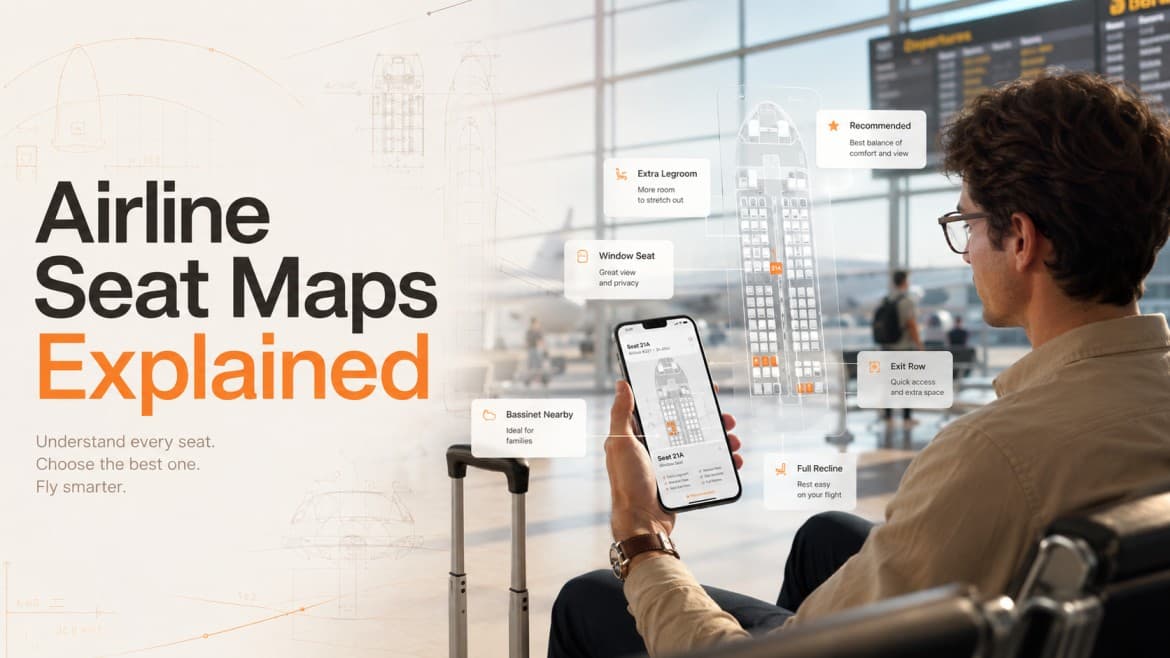
How to Pick the Best Airplane Seat: A Practical Guide for Every Flight
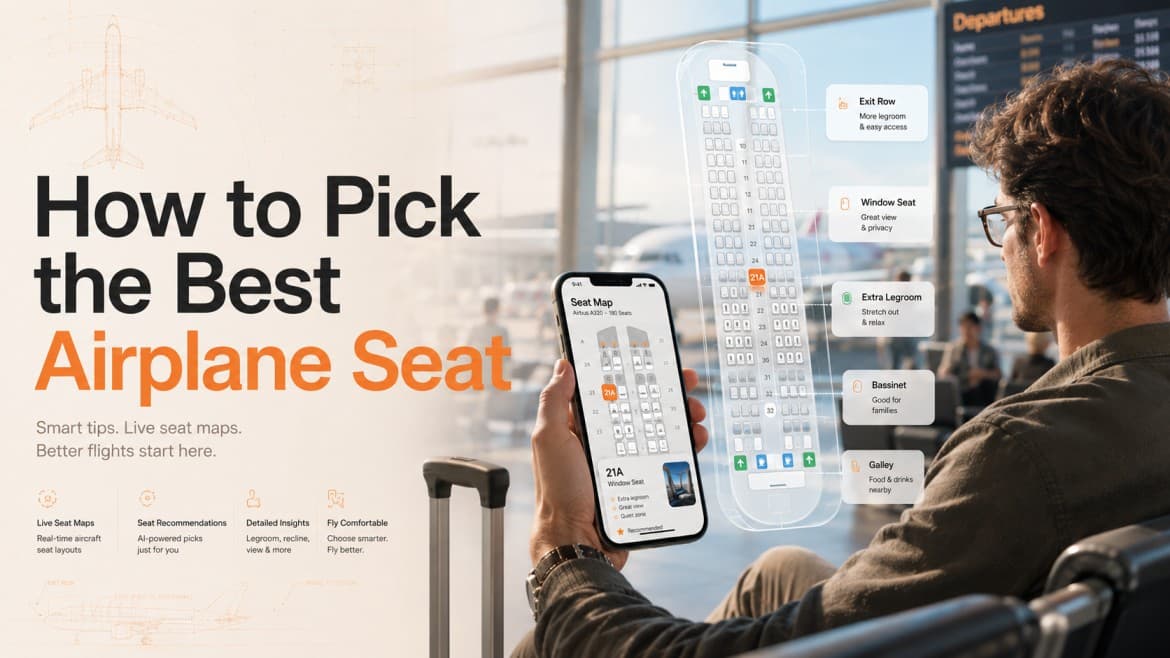
Two passengers pay the same fare on the same flight. One stretches out by a real window with usable legroom; the other spends six hours next to a lavatory door in a seat that barely reclines. The difference wasn’t luck, it was five minutes of seat-map homework.
The best airplane seat is the one that matches your flight length, your priorities, and the actual aircraft you’re flying, and the only way to find it is to check the real cabin map before you choose. This guide covers the rules that hold on almost every aircraft, the seats to avoid, and the strategy for each type of trip.
Step 1: Know Your Actual Aircraft
Everything else depends on this. Airlines fly multiple versions of the same aircraft type with different cabins, one carrier’s Boeing 777 might have three distinct layouts, and seat 21A can be an exit-row gem on one and a windowless wall seat on another.
Don’t rely on the generic type shown at booking. Search your airline and flight number on a seat-map tool like SeatInfo, which resolves the exact aircraft version scheduled for your flight and shows the cabin to scale. Choosing from the wrong map is how people end up surprised at boarding.
Step 2: Settle the Window vs. Aisle Question
There’s no universal winner, only a match for your priorities:
- Choose a window if you want to sleep against the wall, control the shade, avoid being bumped by carts and passengers, or you’re flying a scenic route. Trade-off: you climb over neighbors to get out.
- Choose an aisle if you have long legs, get up often, want to deplane faster, or drink a lot of water on long flights. Trade-off: cart traffic, elbow knocks, and neighbors climbing over you.
- Avoid the middle unless you’re traveling as a pair or trio and can claim window + aisle around it.
One caveat the booking page won’t tell you: not every window seat has a window. Some rows sit against air-conditioning ducting or structural panels, leaving a blank wall. A to-scale seat map shows plugged and misaligned windows before you pay for one.
Step 3: Understand the "Premium" Rows Before Paying for Them
Exit rows offer the most legroom in economy, but read the fine print of the specific row:
- On many aircraft the first of two exit rows has limited or no recline (the row behind it needs the exit clear).
- The door mechanism can intrude into footwell space on some seats, visible on a to-scale map, invisible on a diagram.
- Armrests are usually fixed (tray tables live inside them), which slightly narrows the seat.
- You must be willing and able to assist in an emergency; no children or infants in these rows.
Bulkhead rows (behind cabin dividers) give you no seat reclining into your face and easy access, but tray tables and entertainment screens fold out of the armrest, there’s no under-seat storage for takeoff, and bassinet positions mean these rows attract infants on long-haul flights.
Step 4: Know the Seats to Avoid
These rules hold on nearly every aircraft:
- The last row, often limited or no recline against the rear wall, closest to lavatories and galley noise.
- Seats directly adjacent to lavatories, queue traffic, door slams, and smells for the whole flight.
- Seats beside galleys on overnight flights, lights and crew activity while you’re trying to sleep.
- The row in front of an exit row, frequently restricted recline.
- “Window” seats with no window, check the map, not the letter.
- Seats where entertainment boxes eat footwell space, common in some aisle and window seats; traveler reviews flag these.
Step 5: Match the Strategy to the Flight
Short-haul (under 3 hours): Prioritize the aisle near the front for a fast exit, or any acceptable seat over paying seat fees. Comfort differences matter less when you’re airborne for 90 minutes.
Long-haul (6+ hours): Comfort compounds. Prioritize legroom, a real window if you sleep against the wall, distance from lavatories and galleys, and, if you’re tall, an exit row with full recline. This is where checking reviews for your exact seat pays off.
Redeyes: The jackpot is an empty row. Check live seat availability close to departure, if the flight is wide open, move to a row where the adjacent seats are unsold and you may get a lie-flat bed for an economy fare. Live maps make this a plan rather than a gamble.
Traveling as a couple: On 3-3 layouts, book window + aisle in the same row. If the middle stays empty, you’ve won extra space; if someone takes it, they’ll almost always swap for your window or aisle.
With kids: Bulkhead rows offer floor space and bassinet mounts; being near (but not next to) a lavatory helps. Book early, adjacent seats disappear fast.
Step 6: Time It Right, and Keep Watching
Seat selection isn’t a one-time decision:
- At booking: Grab the best seat available, even if imperfect. It’s your fallback.
- Between booking and departure: Better seats open up constantly, elite upgrades clear, passengers change flights, blocked seats release. A seat-availability alert (SeatInfo Pro) watches your flight and notifies you the moment your target seat frees up.
- Watch for aircraft swaps: Airlines change equipment more often than travelers realize, and your carefully chosen 14A may not exist on the new plane. Swap alerts catch this before the airport does.
- At online check-in: A final wave of seats often releases. One last look at the live map takes thirty seconds.
Frequently Asked Questions
What is the best seat on a plane? For most travelers on most flights: a window or aisle seat in the forward half of the cabin, away from lavatories and galleys, on a row with full recline. The exact best seat depends on the specific aircraft, always check the real cabin map for your flight number.
Are exit row seats worth it? Usually yes for legroom, but verify the specific row: the first of two exit rows often has restricted recline, and door mechanisms can reduce footwell space on some seats.
Is the front or back of the plane better? The front is generally quieter, smoother, faster to deplane, and served first. The back boards earlier on some airlines and may have more empty seats on lightly booked flights.
How do I know if my window seat actually has a window? Check a to-scale seat map for your exact aircraft version. Misaligned and plugged windows are a known issue on many aircraft and aren’t shown on airline booking diagrams.
When should I pick my seat? At booking, then keep monitoring. Seats open up as departure approaches, and alerts can automate the watching for you.
The Bottom Line
Picking the best airplane seat comes down to a repeatable process: identify your exact aircraft, match window/aisle and premium rows to your priorities, rule out the known bad seats, and keep watching until departure. Every step gets easier with an accurate map, search your flight number on SeatInfo, see the cabin to scale with live availability, and board knowing exactly what’s waiting in your row.
chủ đề
Chia sẻ bài viết này
Biết ai đó đang cân nhắc chuyến đi tương tự? Gửi nó theo cách của họ.
Được xuất bản lần đầu trên blog SeatInfo. Xem nguồn